
Exponential Notation Calculator
Very large and very small numbers are easier to read in exponential notation: 0.000 000 47 becomes 4.7 × 10⁻⁷, or 470 nano-units in engineering form. This calculator converts any number between standard, scientific, E-notation and engineering notation at the significant figures you choose, and names the matching SI prefix — useful for science homework, electronics and spreadsheets.
- Free to use
- No sign-up
- Runs in your browser
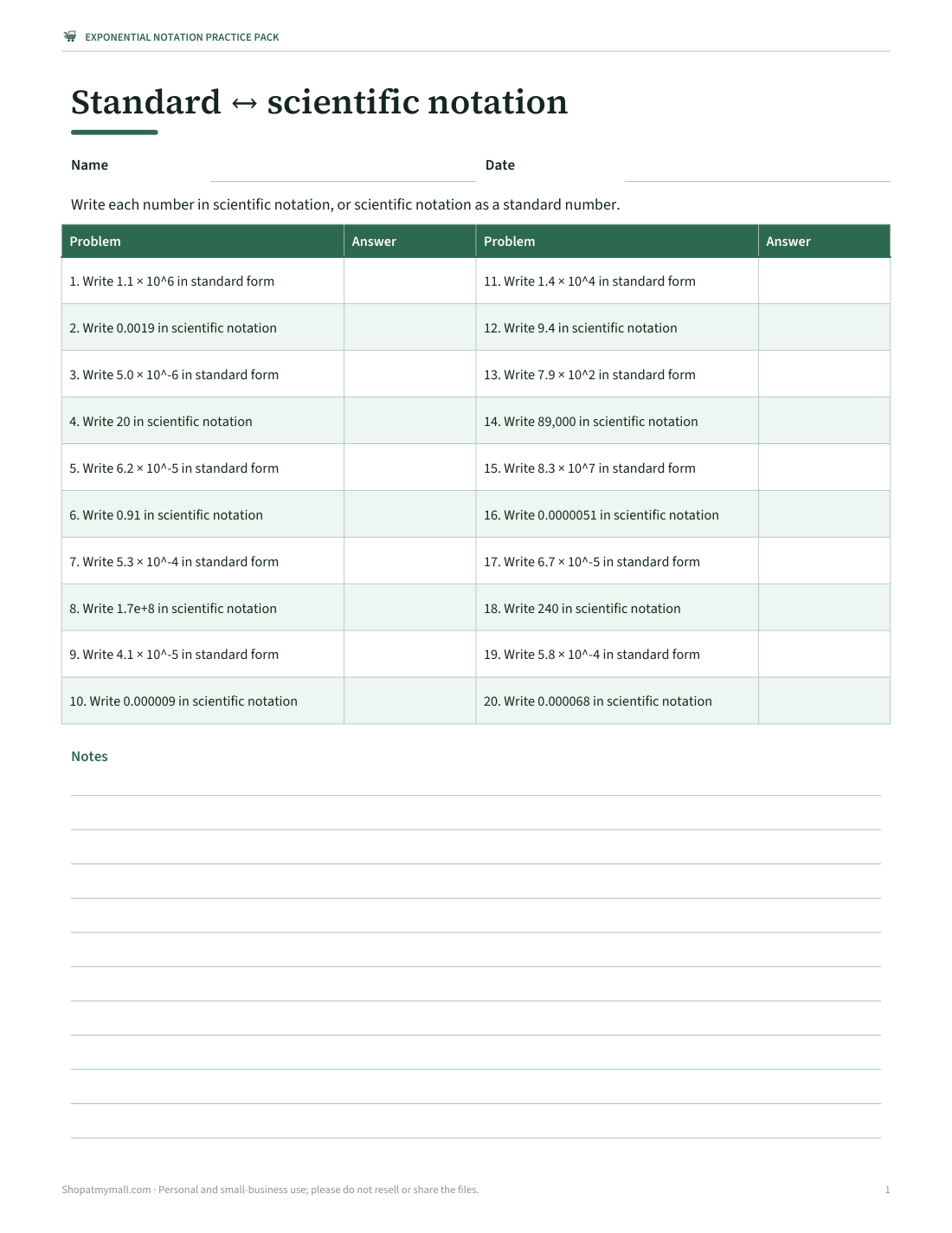
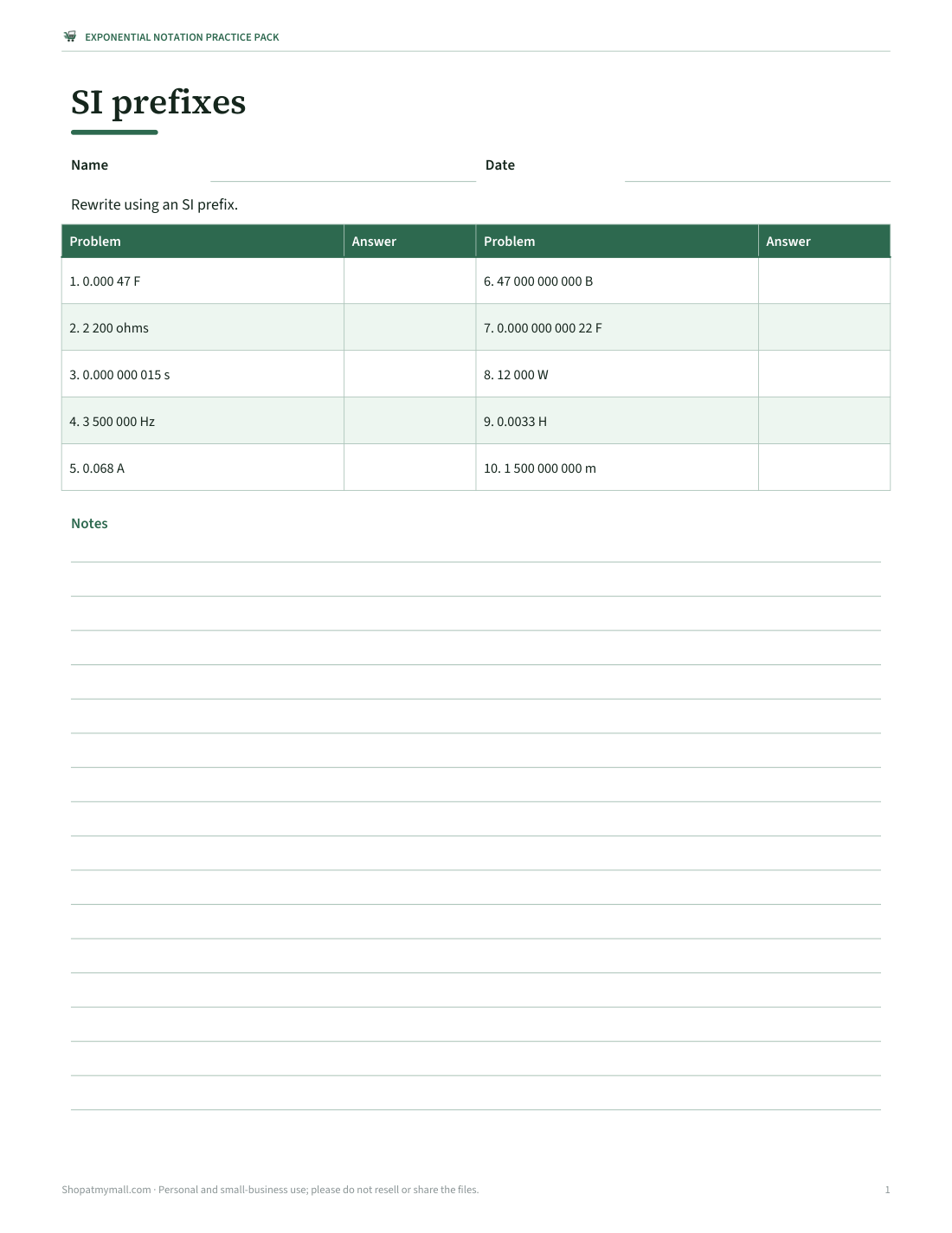
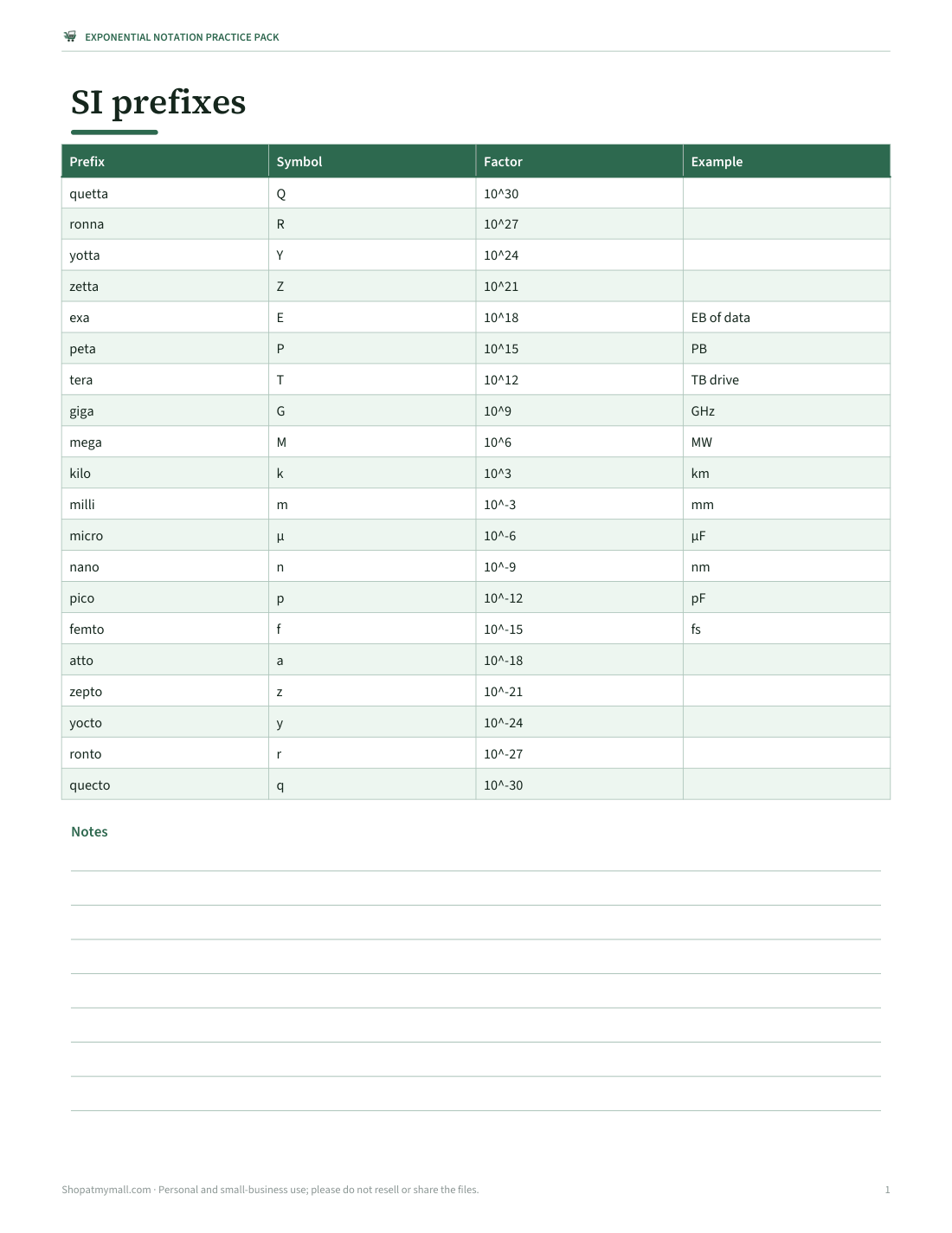
Exponential notation converter
Exponential Notation Practice Pack
Printable exponential notation worksheets with answer keys, an SI prefix chart, an exponent rules card and an Excel conversion sheet.
- Conversion worksheet (PDF/DOCX)
- Engineering / SI worksheet (PDF/DOCX)
- SI prefix chart (PDF/XLSX)
- Excel converter (XLSX)
Formats: PDF, DOCX, XLSX. Instant download after payment (link valid 72 hours, up to 5 downloads). AI-assisted: the templates were drafted with AI help and reviewed and laid out before publishing.
$5.00 USD, one-time 4 files · about $1.25 each
- Instant download
- 7-day refund
- Secure checkout by Stripe
7-day money-back guarantee. Full refund within 7 days of purchase, even after you download.
Free sample: Scientific Notation Worksheet (PDF, 76 KB)
Full refund within 7 days — see the refund policy and license.
Free printables
Single sheets you can print right now, no sign-up. The full pack adds every sheet in one download plus the editable files.
 Printable Scientific Notation Conversion Worksheet
 Printable SI Prefix Worksheet
 Printable SI Prefix Chart
 Exponential Notation Converter Sheet
Four ways to write the same number
| Form | Example | Rule |
|---|---|---|
| Standard (decimal) form | 0.000 000 470 | Ordinary digits |
| Scientific notation | 4.70 × 10⁻⁷ | One non-zero digit before the point |
| E-notation | 4.70E-7 | Used by calculators, spreadsheets and programming languages |
| Engineering notation | 470 × 10⁻⁹ | Exponent is a multiple of 3, matching SI prefixes |
| With SI prefix | 470 nF | Prefix replaces the power of ten |
SI prefixes
| Prefix | Symbol | Power of ten |
|---|---|---|
| tera | T | 10¹² |
| giga | G | 10⁹ |
| mega | M | 10⁶ |
| kilo | k | 10³ |
| (none) | 10⁰ | |
| milli | m | 10⁻³ |
| micro | µ | 10⁻⁶ |
| nano | n | 10⁻⁹ |
| pico | p | 10⁻¹² |
| femto | f | 10⁻¹⁵ |
The SI system also includes larger and smaller prefixes, including ronna, quetta, ronto and quecto added in 2022. Note that k is lowercase for kilo and M uppercase for mega, while m is milli — case matters.
Significant figures in exponential form
Exponential notation makes significant figures unambiguous. Written as 4700, it’s unclear whether the zeros are significant; written as 4.7 × 10³ there are two significant figures, and 4.700 × 10³ shows four. When converting a measurement, keep the same number of significant figures as the original — the calculator uses the figures you type unless you choose a fixed number.
Worked example: capacitors and distances
A capacitor marked 470 nF is 470 × 10⁻⁹ F = 4.70 × 10⁻⁷ F = 0.000 000 470 F — the calculator shows all these forms from any one of them. At the other end of the scale, the average distance from Earth to the Sun, about 149,600,000 km, is 1.496 × 10⁸ km in scientific notation, 149.6 × 10⁶ km in engineering notation, and 1.496E+8 in a spreadsheet.
Exponent rules
| Rule | Example |
|---|---|
| Multiply: add exponents | (2 × 10³)(3 × 10⁴) = 6 × 10⁷ |
| Divide: subtract exponents | (8 × 10⁶) ÷ (2 × 10²) = 4 × 10⁴ |
| Power: multiply exponents | (10³)² = 10⁶ |
| Add or subtract: match exponents first | 3 × 10⁴ + 5 × 10³ = 3.5 × 10⁴ |
| Normalise | 25 × 10³ = 2.5 × 10⁴ |
Where you’ll see each form
- Scientific notation: science classes, textbooks and research papers.
- E-notation: calculator displays (4.7E-7), Excel and Google Sheets, CSV files and code.
- Engineering notation and SI prefixes: electronics (µF, kΩ, MHz), computing (GB, ns) and engineering drawings.
- Standard form: everyday numbers, finance and when readers aren’t used to exponents.
Converting by hand
- Move the decimal point until one non-zero digit is in front of it.
- Count the places moved: that is the exponent.
- Moving left (for big numbers) makes the exponent positive; moving right (for small numbers) makes it negative.
- Keep the significant figures from the original number.
- For engineering notation, choose the nearest lower exponent that is a multiple of 3 and adjust the mantissa (it will be between 1 and 999).
Example: 0.000 470 → move the point four places right → 4.70 × 10⁻⁴. In engineering notation that is 470 × 10⁻⁶, or 470 µ.
Common mistakes
- Writing 47 × 10⁻⁸ as scientific notation — the coefficient must be between 1 and 10 (4.7 × 10⁻⁷).
- Confusing m (milli, 10⁻³) with M (mega, 10⁶).
- Typing 10E5 on a calculator when you mean 1 × 10⁵ (10E5 is 10 × 10⁵ = 10⁶).
- Dropping significant zeros: 4.70 and 4.7 are different measurements.
- Forgetting that a negative exponent means a small number, not a negative one.
Orders of magnitude in everyday science
| Quantity | Approximate value |
|---|---|
| Diameter of a hydrogen atom | 1 × 10⁻¹⁰ m |
| Wavelength of green light | 5 × 10⁻⁷ m (500 nm) |
| Width of a human hair | 7 × 10⁻⁵ m (70 µm) |
| Speed of light | 3.00 × 10⁸ m/s |
| Earth–Sun distance | 1.496 × 10¹¹ m |
| Avogadro constant | 6.022 × 10²³ per mole |
Comparing exponents gives a quick sense of scale: a hair is roughly a hundred times wider than the wavelength of light and roughly a million times wider than an atom.
E-notation in spreadsheets and code
Spreadsheets switch long numbers to E-notation automatically — 123456789012 may display as 1.23457E+11. Widen the column or apply a number format to show all digits. Most programming languages read E-notation directly: 4.7e-7 in JavaScript, Python or C is the same value as 0.00000047. Large identifiers such as barcodes or account numbers should be stored as text so they are never converted.
The practice pack
The optional pack includes printable conversion worksheets with answer keys, an SI prefix chart with examples, an exponent rules card and an Excel converter sheet. The converter on this page is free.
AI-assisted content
This page was drafted with AI assistance and reviewed before publishing.
Frequently asked questions
What is exponential notation?
Writing a number as a coefficient multiplied by a power of ten, such as 4.7 × 10⁻⁷.
What is the difference between scientific and engineering notation?
Scientific uses one digit before the point; engineering uses exponents that are multiples of 3.
What does E mean on a calculator?
“Times ten to the power”: 4.7E-7 means 4.7 × 10⁻⁷.
What is 1 × 10⁻⁶ called?
Micro (µ).
How many significant figures does 4.70 × 10³ have?
Three.
Can I type SI prefixes?
Yes — for example 470n, 2.2k or 10µ.
How do I enter scientific notation in Excel?
Type 4.7E-7; format the cell as Scientific to display it that way.
Is 0 written in scientific notation?
Zero is simply 0; it has no meaningful exponent.
What is 1,000,000 in scientific notation?
1 × 10⁶, or one million.